the crisis is no longer theoretical…it’s already unfolding in real time.
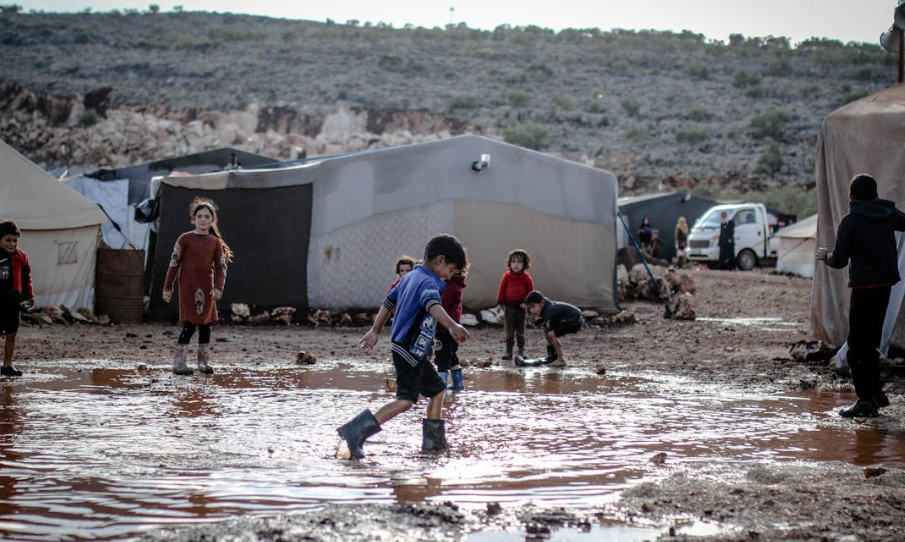
Refugee kids playing between their wet tents in cold winter
Recent reports show that extreme weather is driving record levels of displacement globally, with 2024 ranking among the highest years ever recorded for climate-related displacement (USCRI). And this isn’t happening in isolation…it’s overlapping with conflict, poverty, and fragile systems.
Take Sudan, for example. While much of the displacement is linked to conflict, climate factors like flooding and environmental stress are making the situation worse, pushing communities into repeated cycles of displacement (iom.int).
This creates something researchers are now calling “double displacement”..where people are forced to move not once, but multiple times due to overlapping crises (ReliefWeb).
And it’s not just one region.
In places like Bangladesh, rising sea levels and environmental degradation are quietly pushing people into cities, where they face overcrowding, poverty, and instability (Refugee Law Initiative Blog).
What we’re seeing now challenges one of the biggest assumptions in policy: that displacement is a single event.
It’s not.
It’s ongoing. Repetitive. And increasingly unavoidable.
A villager trying to walk around her drained house due to climate
In my previous post, I talked about the growing reality of climate refugees and how environmental change is forcing people from their homes. But what I didn’t fully explore is this: even when we acknowledge climate displacement, the legal system still doesn’t know what to do with it.
A study from the Chicago Journal of International Law takes this issue further by exposing a critical flaw…not just the lack of recognition, but the mismatch between how climate displacement actually happens and how the law is structured to respond.
People don’t always leave because of one disaster. It’s often a slow accumulation drought that destroys income, rising sea levels that contaminate water, economic collapse that follows environmental damage. By the time someone leaves, climate change is part of the story… but not the whole story.
And that’s where protection fails.
Because if climate change isn’t the only reason someone migrates, they are often denied protection altogether.
One of the most overlooked challenges is proving that climate change is the primary cause of displacement.
Unlike political persecution, which can sometimes be documented, environmental harm is harder to trace to a single moment or event. The burden of proof falls on individuals who are already in vulnerable situations.
So the system ends up asking the wrong question: “Can you prove climate change forced you to leave?”
Instead of asking: “Is it safe..or even possible..for you to go back?”
When Staying Is No Longer Living
Another idea that shifted my perspective is how the law defines “danger”
Right now..protection is usually triggered by immediate threats to life. But climate change often creates conditions that are unlivable long before they are technically “deadly”
Crops fail
Water becomes unsafe
Jobs disappear
Communities collapse
People are not always fleeing death..they are fleeing the slow erosion of any possibility of a future.
And yet, legally, that still might not be “enough”
A System That Reacts Too Late
What this research made clear is that international law is reactive..it waits for crisis at its most extreme point.
But climate displacement is different. By the time it becomes undeniable, it’s often too late for safe, stable relocation.
This raises a difficult question:
Why does the system require people to reach the edge of survival before recognizing their need for protection?
My final reflection
What I’m starting to realize is that the issue isn’t just that climate refugees aren’t recognized…it’s that the framework we’re using was never built for this kind of crisis.
Climate displacement blurs every boundary the law depends on:
voluntary vs. forced migration
environmental vs. political causes
internal vs. cross-border movement
And until those boundaries are rethought, people will keep falling through the cracks.
This isn’t just a gap in policy. It’s a gap in how we understand displacement itself.
When people think about climate change, they often imagine melting ice caps or rising temperatures. But for millions of people, climate change means something much more personal …losing their homes and being forced to migrate. Climate refugees are individuals and families who must leave their communities because environmental conditions make it impossible to stay.
This blog focuses on the human impact of climate change, especially how displacement affects families, mental health, and social stability. Understanding climate refugees helps us see that environmental problems are also social and humanitarian issues.

 Writing About the Environment