Sea level rise is just that: The ocean’s baseline is getting higher. This is driven by both warming water expanding and ice caps melting. This may seem like a gradual major change, almost like knowing the sun will explode in a few billion years, but it’s already happening.
Maryland has more than 3,000 miles of shoreline, so while that water is so close sea rise could pose an issue; erosion is also at play, physically taking away land. This process is then doubled for the eastern shore facing the Chesapeake Bay and the Atlantic Ocean.
We can measure erosion but how do we measure sea level rise?
There are several scenarios based on how well emissions are reduced by 2050. If global emissions are reduced to net zero there would still be 1-3 feet of rise by 2100. If emissions are unchecked sea level rise would reach 2-5+ feet. This may not feel like that big of a change since the minimum and maximum emission results overlap but one more foot of sea level could mean thousands of additional square miles of land are underwater.
The worst of this will be seen on the eastern shore. Specifically, Dorchester and Somerset counties have already experienced saltwater entering farm fields and ghost forests. These forests happen when saltwater takes over and kills trees. Populated locations like Annapolis and Baltimore already experience some flooding on hot days during high tide, and it’s only going to happen more.
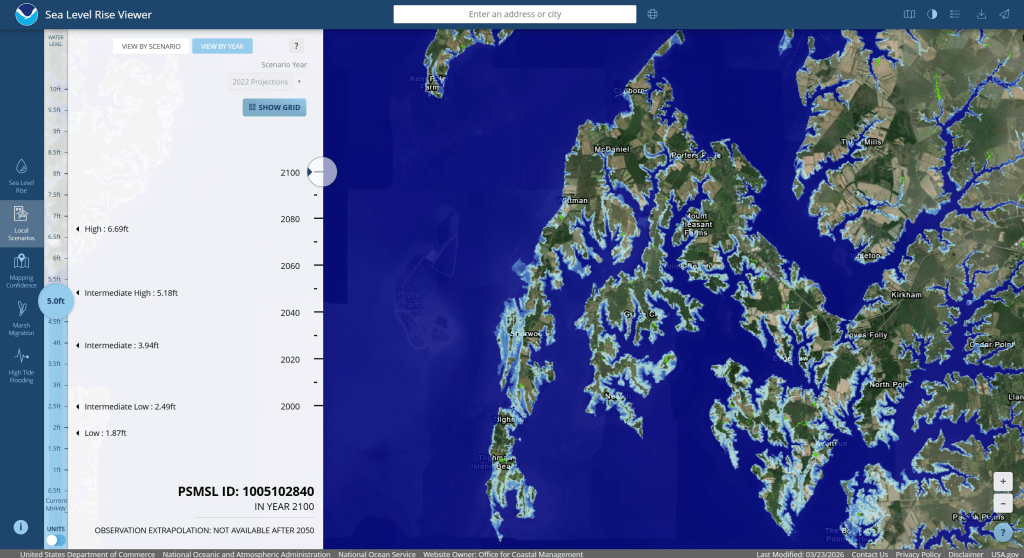
(NOAA’s Sea Level Rise Viewer )
Using NOAA’s Sea Level Rise Viewer, I can see how by 2100 my home county Tilghman, will be mostly underwater. Additionally, the island covered by blue in the center is Poplar Island, a real life example of the impacts erosion and sea level rise can have.
So what does this mean for people in the danger zone?
Infrastructure, like roads in low areas will need to be raised or rerouted. Septic systems could fail near the coast due to the groundwater rising. Many home owners will need to find flood insurance and anticipate loss of property value as the coast creeps forward. There are many strategies to reduce flooding near your house; however, reducing emissions is the best way to reduce sea level rise, as even a one foot increase has a massive impact on the shoreline.
Read more at:
https://www.umces.edu/sea-level-rise-projections
https://extension.umd.edu/programs/environment-natural-resources/program-areas/coastal-climate-program/sea-level-rise/


Leave a comment