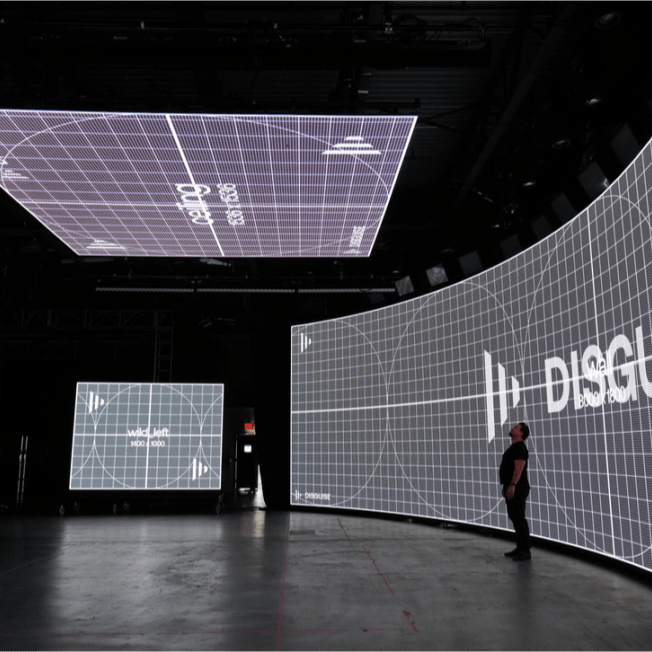
(Photo inside Disguise’s studio, Disguise, n.d.)
In my last post, I discussed how virtual production (VP) is revolutionizing film production and its sustainability. We discussed how VP can save studios thousands of dollars by eliminating cross-country shooting and reducing CO2 emissions by up to 50%. However, while the technology is a massive step forward, we haven’t spent much time on its significant downsides—specifically, its high power consumption.
With a technology that relies solely on computer systems and hardware to create fantastical worlds, travel emissions are traded in for increased power use rather than being eliminated. For instance, the centerpiece of VP, the LED volume, is also its biggest energy hog. In some scenarios, energy used for LED panels can account for up to 87% of a production’s total energy emissions (Cabello 16). Thousands of individual LED panels generate heat, which creates a secondary environmental problem: prolonged HVAC usage; cooling systems must run constantly to mitigate the stage temperature, with HVAC alone responsible for nearly 77,400 gCO2/min in some studio setups (Cabello 16).
VP’s production isn’t the only thing to recognize. Additionally, the process of extracting raw materials to create LED panels is an expensive part of the overall detriment of the environment. Take into account the eventual disposal of the complex hardware, and the claims of 50% reduction may be unlikely (Willment 6). As Nina Willment (2015) put it, to truly understand if VP is “better,” we have to account for the entire supply chain, from resource extraction to electronic waste (Willment 6).
In conclusion, virtual production isn’t a magic wand in; it trades non-renewable fuel for electricity, and that electricity comes with a heavy price tag.
Cabello, Esther, et al. “Virtual vs. Conventional Production for Film and Television: A
Comparative Life Cycle Assessment.” UCLA Institute of the Environment and Sustainability, June 2023, https://www.ioes.ucla.edu/wp-content/uploads/2023/06/UCLA-IoES-Practicum-SPA-Virtual-Production-Final-Report-2023.pdf.
Willment, N. “The Evolution of Virtual Production? Issues and Opportunities.” University of York., November 2023,

 Writing About the Environment
Leave a reply to cbomysoa Cancel reply