Keyword phrase: snowmobile noise and birds
Winter in Yellowstone often appears quiet, but new ecological research shows that the landscape is far more acoustically fragile than it seems. Recent findings highlight how interactions between snowmobile noise and birds shape the winter soundscape in subtle yet significant ways. Scientists have begun using advanced acoustic monitoring tools to understand how the presence of snowmobiles affects the communication patterns of overwintering species that depend on sound for safety, foraging, and early social bonding.
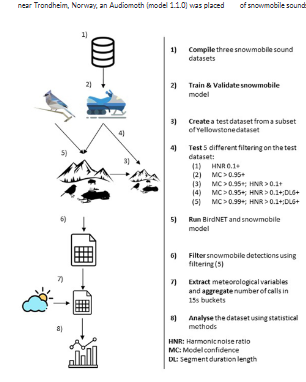
Using more than forty three thousand hours of audio recordings collected across Yellowstone National Park, researchers trained a deep learning model to identify snowmobile noise with high accuracy. They then examined how bird vocalizations changed before and after these noise events. The results were consistent across multiple sites in the park. In both morning and evening hours, bird vocalizations declined in the minutes leading up to a snowmobile’s arrival. After the engine noise passed, vocal activity rebounded and, in some cases, exceeded baseline levels. These patterns suggest that birds reduce calling behavior when they detect distant engine noise, possibly as a cautionary response, and then resume normal communication once the disturbance has ended.
This matters because winter communication is not optional for birds. During the non-breeding season, birds form flocks, maintain group cohesion, and avoid predators through subtle acoustic cues. Interruptions to these behaviors can have cascading effects on energy budgets, habitat use, and even pre breeding social structure. Yellowstone enforces noise reduction measures for over snow vehicles, and the observed changes in vocalizations occurred even under these regulated conditions. Parks or recreational areas without such restrictions may experience stronger ecological impacts.
The study also demonstrates how new technologies are transforming environmental monitoring. Automated sound analysis makes it possible to detect wildlife responses that were previously hidden in large datasets. These tools expand the ability of conservation managers to understand how human recreation affects ecosystems, especially in winter when animals are already operating near the limits of their survival.
As climate pressures, land use conflicts, and winter tourism continue to reshape protected landscapes, managing sound becomes just as important as managing space. Understanding the interaction between snowmobile noise and birds is a step toward safeguarding the quieter parts of wilderness that wildlife relies on most.
Cretois, Benjamin, et al. “Snowmobile Noise Alters Bird Vocalization Patterns During Winter and Pre Breeding Season.” Journal of Applied Ecology, vol. 61, 2024, pp. 340–350. Snowmobile noise alters bird vocalization patterns during winter and pre‐breeding season
Burson, Shan. Winter Acoustic Monitoring in Yellowstone National Park, December 2017 to March 2018. National Park Service, 2018. National Park Service DataStore, File 632415Natural Soundscape Monitoring
 Writing About the Environment
Leave a comment