Artificial intelligence is often framed as something that benefits everyone. It helps write essays, recommend content, and optimize systems in ways that feel efficient and almost invisible. But the environmental costs behind AI are not shared equally, and that’s where the conversation becomes more complicated.
The infrastructure powering AI, especially data centers, requires enormous amounts of energy, water, and land. But these facilities are not randomly placed. Research shows they are often built in communities that already face environmental burdens, including low-income neighborhoods and communities of color. These areas end up dealing with increased water use, strain on local energy systems, and added pollution, while the benefits of AI are distributed much more broadly .
This pattern reflects a larger concept known as climate justice. Instead of only asking how much environmental damage is happening, climate justice asks who is experiencing it and who has a voice in those decisions. Scholars argue that AI’s environmental impact should be understood through both distributional justice, who bears the costs, and procedural justice, who gets to participate in decision-making . In many cases, the communities most affected by AI infrastructure have the least influence over whether these projects are built in the first place.
What makes this issue even more complex is that AI is often discussed as part of a sustainable future. It is marketed as a tool for efficiency, innovation, and even climate solutions. But at the same time, its rapid expansion is creating what some researchers describe as a new kind of “infrastructure divide,” where certain regions carry the environmental weight of supporting global digital systems .
This raises an important question: can a technology be considered “advanced” if its environmental costs are unevenly distributed?
Artificial intelligence may feel like a shared global resource, but the reality is more uneven. Some communities experience AI as convenience, while others experience it as an increased strain on their environment and resources. Understanding AI through the lens of environmental inequality makes it clear that the issue is not just about technology, it is about fairness.
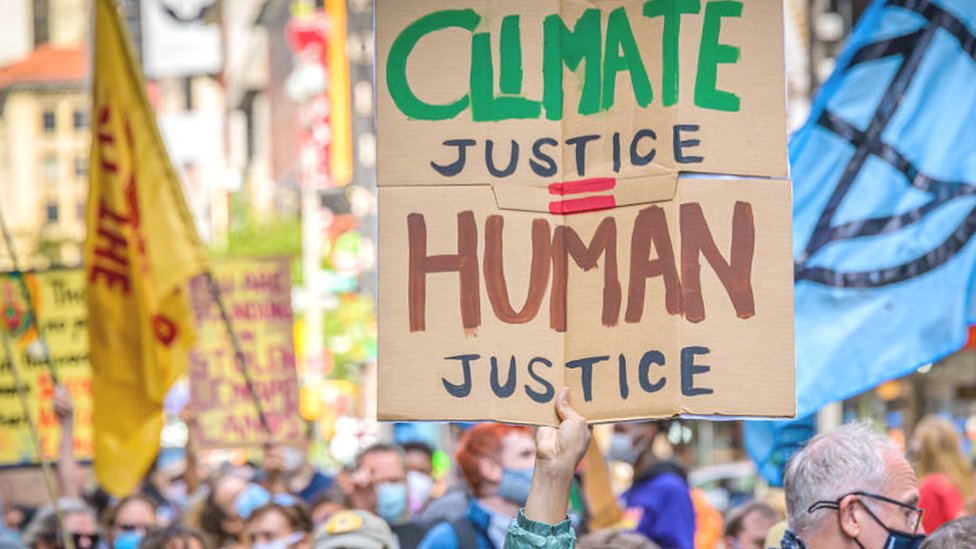
Alt text: Crowd of protesters in a city street holding signs, with one large sign in the center reading “Climate Justice = Human Justice,” emphasizing the connection between environmental issues and social equity.
References:
“From Global Justice to Climate Justice: Justice in a Changing Climate.” New Political Science, vol. 31, no. 4, Duke University Press, pp. 499–—.
“Artificial Intelligence and Environmental Inequality.” Global Society, Wiley Online Library, 2025, https://onlinelibrary.wiley.com/doi/abs/10.1002/gas.70012
 Writing About the Environment
Leave a comment