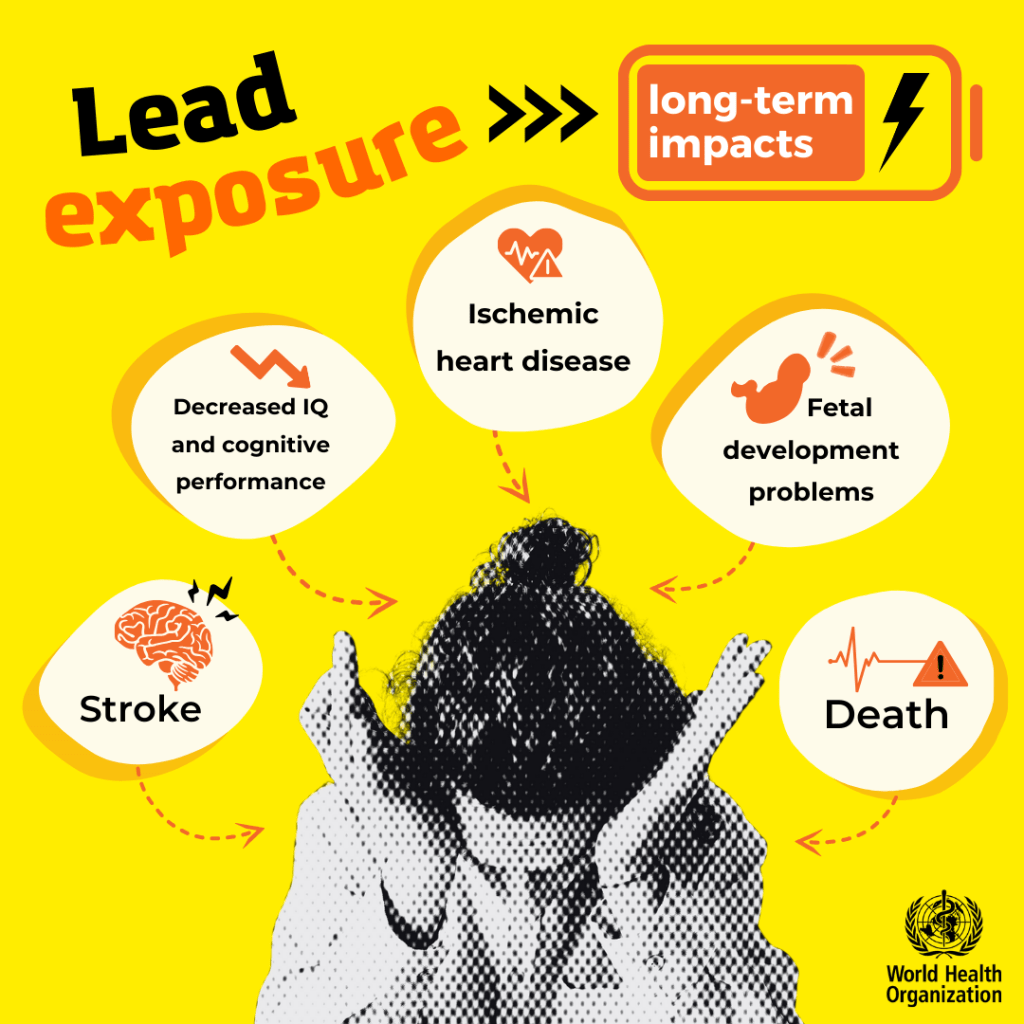
Experts agree that there is no safe level of lead that can be consumed. But what exactly happens when it is consumed? Does the amount of lead result in different effects? Here is what can happen.
First, it is important to note that children ingest more lead than adults, particularly from the ages of 0 to 3 years. Lead interferes with the neurodevelopment of the child and can lead toxicity can decrease IQ, can cause behavioral problems, hyperactivity, seizures, and impaired coordination. A blood lead level of 2.5 µg/dL to 10 µg/dL can result in a drop of 3.9 IQ points.
Lead accumulates in the body over time. For pregnant individuals, lead is released from the bones (as calcium is) during the formation of the fetus’s bones. This can result in reduced growth of the fetus. Since lead can cross the placental barrier and exposes the fetus to lead, there can be a premature birth. For nonpregnant adults, lead can cause cardiovascular effects (ex. increased blood pressure, hypertension), decreased kidney function, and reproductive problems.
References:
https://pmc.ncbi.nlm.nih.gov/articles/PMC6959527/
https://www.epa.gov/ground-water-and-drinking-water/basic-information-about-lead-drinking-water#health
 Writing About the Environment
Leave a comment